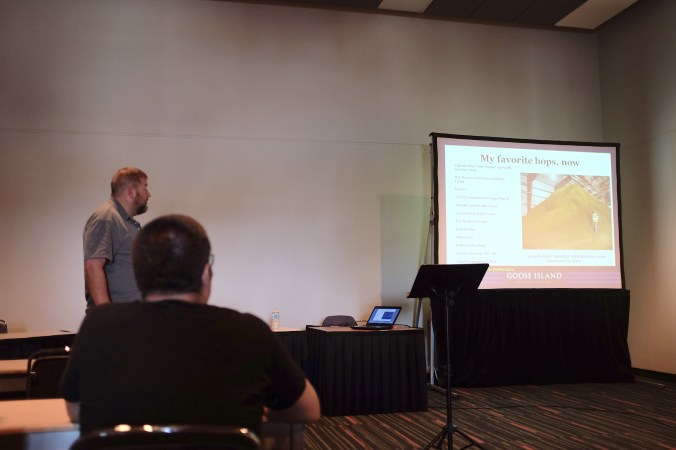
Goose Island Brewmaster, Brett Porter lists his favorite hops at the Mondial de la bière Master Classes.
At Mondial de la bière, an annual beer festival known around the world as one of the most prominent in North America (held for the 23rd year in Montreal at the Palais de Congres June 8-12, 2016), a new initiative was introduced to festival-goers this year: the Master Classes.
Launched in partnership with Goose Island Beer Co. and targeted to industry professionals (along with avid homebrewers and connoisseurs), the new feature brought three world-famous brewers to classroom settings to share their insights into different aspects of the brewing business: Yvan De Baets, Brasserie de la Senne; Leonardo Di Vincenzo, Birra Del Borgo; and Brett Porter, Goose Island brewmaster, who led a session on hops sourcing in a time of shortage, an issue which many craft breweries are facing today.
Along with filling in audience members on his history in the beer industry—which spans 28 years between Bunces Brewery in England, Portland and Deschutes breweries in Oregon, and the past six years at Goose Island—Porter stressed the importance of seeking out and cultivating relationships with hops farmers. In his experience, he said, hop growers are the most “open, welcoming and happy people” in the world, and knowing the right people to call will invariably lead to hops-sourcing success. Toward the end of the session, Porter shared a list of his favorite hops to brew with, along with (in most cases) the farms he works with to acquire them. Continue reading →
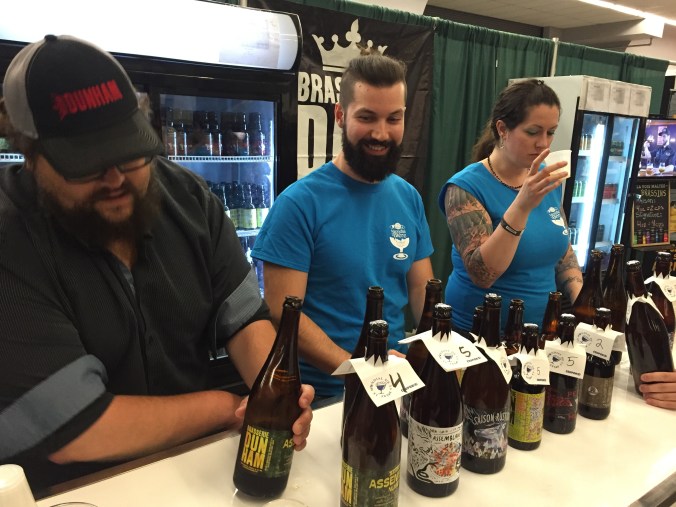
Simon Gaudreault, co-owner of Brasserie Dunham, with a bottle lineup at Mondial de la bière 2016.
Among the 536 beers and 586 total beverages offered by more than 85 breweries present at the 23rd Mondial de la biere in Montreal, none stood more than those of Brasserie Dunham (Dunham Brewery), a microbrewery specializing in farmhouse style and wild ales located about an hour southeast of Montreal.
The brewery first caught our eye (along with our nostrils and tastebuds) at Les Terrasses Flaveurs, a beer and caprices tasting organized by Quebec-based beer and gastronomy expert, author and speaker, Philippe Wouters. The pairing experience was organized in stations, the second of which paired caprices from Au Petit Extra with two of Brasserie Dunham’s expert creations:
First Pairing: Spring roll with mango, ginger and tempeh, paired with Brasserie Dunham Saison Fleurs Sauvages.
This spring roll was the best either of us have ever had in our lives—no, seriously. Nothing like the greasy, crispy cylinder stuffed with cabbage and carrot that we’re used to. Refined yet approachable, this roll was fresh, delicate and grease-free, prepared more like a maki with miniature rice noodles in place of the rice and a moist, translucent rice paper skin in place of the seaweed. The best part was the fresh ginger, first enveloped within the spring roll’s fragrant folds, then bursting to life on the tongue with that quintessential ginger zing. (We weren’t the only ones talking about this roll all weekend.)
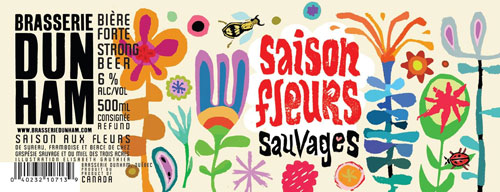
The Saison Fleurs Sauvages bottle label; each beer label at Brasserie Dunham is designed by a different local artist. Image via brasseriedunham.com.
Saison Fleurs Sauvages, or saison with wild flowers (6% ABV), was a perfect pairing, equally fragrant and refined at its delicate core, with its own set of unique nuances. According to Dunham co-owner, Simon Gaudreault (who is also an accomplished wine sommelier and writer), the saison includes three types of wild flowers: raspberry (little white flowers that grow with the berry); elderflower (also little and white, often used in herbal remedies and recently, in craft beers); and berce flowers, for which he nor I could find an English translation.
Second Pairing: Dark malt bread with smoked salmon “nuggets,” paired with Brasserie Dunham Assemblage #1.
The caprice here was essentially a small piece of rye bread toast with a shmear of butter, lox-like smoked salmon pieces, and topping of dill-weed. Like fancy lox on a bagel with a hearty crunch, the fat of the butter and salt of the salmon were cut exquisitely by the funky, dry and bitter formulation of Assemblage 1.
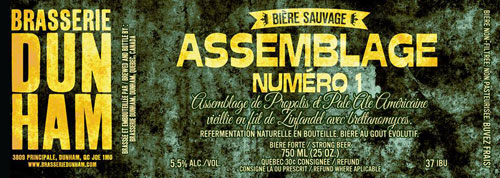
Assemblage Numéro 1, a wild beer blend aged in Zinfandel barrels.
Assemblage 1is a blend of American Pale Ale and saison with honey (or more accurately, propolis) aged in Zinfandel barrels with brettanomyces yeast. Read that again. It’s delicious! Funky, rustic, fruity, hoppy…it’s all there, and it’s truly special. According to the brewery, Assemblage 1 is the first “assembly” or blend in which the effect of the barrels transcends the two base beers. Voila.
Fun fact: Dunham brewery is located in Dunham, Quebec, not far from the U.S. border. As such, the brewery has done a few collaborations with American brewers—Hill Farmstead and Cambridge Brewing Co. among them. Trust me, you’ll want to keep your eye out for these guys.
They never stop experimenting, either: in fact, on May 22, 2016, Dunham released no fewer than 22 beers for an event Gaudreault described as a bottle release that was enhanced for its attendees with games, giveaways and other merriments meant to make waiting in line less miserable. Plus, the releases were all pre-order, so no one walked away empty handed.
I’ll close with this video created for the brewery last June : “Brasserie ze film” by Alex Chabot. (Disclaimer: it’s in French.)
The shower beer can be many things: post-workout hydration, multitasking before a night out, or simply a refreshing pick-me-up while washing. For Lewis Kent, the Beer Mile world champion, shower beers are both post-race liquid trophy and pregame ritual. “After a race or a hard workout, when I come home and I’m getting ready to go out with friends, it’s nice to have a little reward,” says Kent.
Craft brewers have caught on to the concept, and a growing number of craft beers billed as “shower beers” are hitting the shelves, providing more flavorful, stimulating options to take into the tub. With warm weather approaching, now is the perfect time to indulge in these palate-scrubbing brews — from a hoppy pilsner to a lime-zested gose to a pale ale bursting with citrus — made for good, clean fun, in the shower and out. Read more on MensJournal.com >
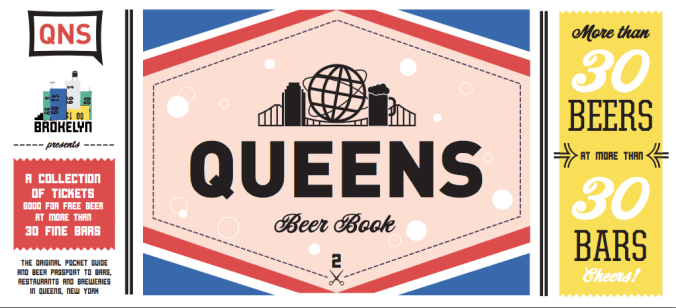
I’m always met with a mixed wave of relief and accomplishment when the Beer Books launch, and for the second year running, this is especially true with the Queens book. Though my several years’ history with the Brooklyn Beer Book can’t be surpassed, the Queens Beer Book, which launched in 2015, holds a special place in my heart. This book was my baby last year, and it’s been a rewarding experience watching it fly the nest and be so well received amongst the craft beer curious in Queens.
The limited-edition book, curated and edited by yours truly, brings beer adventuring beyond Brooklyn’s borders, offering an easy, affordable way to discover the exploding craft beer scene in Queens. Buying one gets you 31 beers at 31 of the best bars, breweries and beer-centric eateries across Queens for just $30, featuring awesome venues in Astoria, Long Island City, Sunnyside, Jackson Heights, Ridgewood, Forest Hills, Whitestone and Bayside.
Rockaway Brewing Co. in Long Island City, Queens. Photo via Brokelyn.
Which is why I’m VERY excited to announce that the 2016 edition is on sale, ready for the next round of beer drinkers to journey through its 31 pages, this time enjoying new bars, breweries and beer halls to accompany some favorites from last year, and nice places to go out while saving a little extra cash.
Good through April 15, 2017, this is an explorer’s guide to great food and drink spots you haven’t been to yet, as well as an incentive to revisit neighborhood favorites. (Want proof of how much fun they are? See the books in action on Instagram.)
2016 Queens Beer Book Venues Include:
60 Bean Kitchen & Coffee • Alobar • Astoria Bier & Cheese (Ditmars) • Beer Belly’s • Beer Closet • Bierleichen • Bierocracy • Bohemian Hall & Beer Garden • Bowery Bay • Bridge & Tunnel Brewery • The Courtyard Ale House • Diamond Dogs • Jagerhaus • John Brown Smokehouse • LIC Beer Project • The Local Bar • Maggie Mae’s • Max Bratwurst Und Bier • The Monk • The Other Place • Press 195 • Proof & Gauge (at Astoria Distilling Co.) • The Queens Kickshaw • The Ridgewood Ale House • Rèst-âü-Ránt • Rockaway Brewing Company • SingleCut Beersmiths • Snowdonia • The Standing Room • Unidentified Flying Chickens • Woodbines
Pick one up now to support local businesses bringing craft beer to life in Queens. Oh, and to get a bunch of free beers while you’re eating and drinking your way through the borough this year.
April 7, 1933 marked the first day in 13 years that the manufacturing of low-alcohol beer and wine became legal. In other words, Americans could legally buy, sell, and drink beer. This happened thanks to FDR signing the Cullen-Harrison Act on March 22, 1933, which went into effect 16 days later. The stipulations and facts:
Beer could only contain up to 4.05% ABV. (Interestingly, alcohol content was actually measured by weight then – the legislation called for 3.2 alcohol by weight.)
States had to enact the law on their own terms. In other words, it was not legal everywhere, but in states that deemed it so (or “wet” states).
1.5 million barrels of beer were consumed that day, which is a fun idea.
This is not the day that Prohibition ended. The 18th Amendment and National Prohibition ended later that year, on December 5, 1933, when the 21st Amendment to the U.S. Constitution was ratified.
Supposedly, the designation of the “holiday” began in 2009 when Justin Smith, a beer enthusiast in Richmond, Virginia, started a Facebook page to celebrate the day. After that, his page, and the designation of National Beer Day, were recognized by 1) a craft beer blogger in Colorado, Eli Shayotovich; 2) the beer check-in app, Untappd, which made a “badge” for the day in 2011; and 3) Twitter, where the hashtag, #NationalBeerDay has been annually trending since.
What a time to be alive.
All the “days” we endure online and in life are mostly trivial, but this one, we guess we can get behind. So today, if you’re looking for a reason to make this different from any other day, raise your glasses to FDR, to beer makers in the 1930s, to that guy in Richmond, and to not ever having to live through 13 beer-free years.
The results are in—the Brewers Association (BA) today announced the top 50 craft brewing companies and top 50 overall brewing companies in the U.S., based on beer sales volume in 2015. According to the BA, 43 of the top 50 overall brewing companies were craft brewing companies, showing that craft breweries “continue to open new markets and expose beer drinkers to a variety of fuller-flavored styles and offerings,” Bart Watson, BA chief economist, said. Additionally, four New York brewing companies made it to the Top 50 U.S. Craft Brewing Companies in 2015.
New York Craft Breweries in the Top 50
Brooklyn Brewery of Brooklyn, New York at no. 12 (compared to no. 11 for 2014);
Duvel Moortgat USA of both Kansas City, Missouri and Cooperstown, New York, parent company of Boulevard Brewing and Brewery Ommegang, at no. 15 (compared to no. 12 for 2014);
Matt Brewing Co. of Utica, New York, brewers of Saranac and other brands, at no. 17 (compared to no. 14 for 2014); and
Brooklyn Brewery also sits at no. 18 for overall brewing companies in the U.S. (compared to no. 17 in last year’s report), with Duvel Moortgat four spots behind at no. 22 (falling from no. 18 last year); Matt at no. 24 (compared to no. 20), and Southern Tier at 40 (compared to 41 for 2014). The highest ranking overall brewing company from New York is North American Breweries, which stood at no. 6 for both 2014 and 2015, and includes the Dundee, Genesee, Labatt Lime, Magic Hat and Pyramid brands.
See how other craft brewing companies stacked up in this infographic from the BA.
Surprised by these stats? Think a brewery from your state deserved a spot in the top 50? Say it in the comments.
“Craft brewers took a world where people didn’t care about flavor or freshness in their beer, and changed it dramatically.” – Victory Brewing Company co-founder, Bill Covaleski
Last month, Victory Brewing Co. of Downington, Pennsylvania and Southern Tier Brewing Co. of Lakewood, New York merged to operate under a holding company formed by private equity firm, Ulysses Management. The two breweries’ new owner, Artisanal Brewing Ventures (amusingly abbreviated ABV), provides “management advice, assistance and vision to a select but growing list of independent craft brewers and distillers,” according to the Ulysses Management website.
The merger can be seen two ways: another pair of craft breweries surrendering their independence to the almighty dollar; or, two craft breweries joining forces to continue fighting the good fight against macro brands, with more money and power behind them than if they continued operating solo. One facet important to note is that ABV is a parent company, and won’t be producing any goods or services itself.
Whether you’re of the “another one bites the dust” camp or the “I’m not surprised/devastated/outraged, business is business” camp (I tend to lean toward the latter, in this case), consider this quote for a moment and let it tell you one sure thing: the beer world is changing, it will continue to constantly change, and a long as we have lots of options for good beers to drink and good people making them, we’re doing alright.
Read more of Covaleski’s response in Men’s Journal’s coverage of the merger here. For the full release, head to stbcbeer.com.
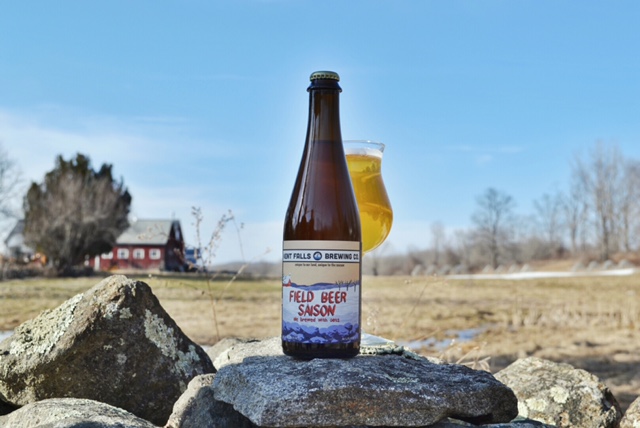
Kent Falls Brewing’s Field Beer, brewed with 100% Connecticut-grown grains and hops.
Brewing beer with 100% local ingredients isn’t easy. These five breweries are making an effort, one beer at a time. Read more—with perspectives from the beers’ brewers and founders—on CivilEats.com.
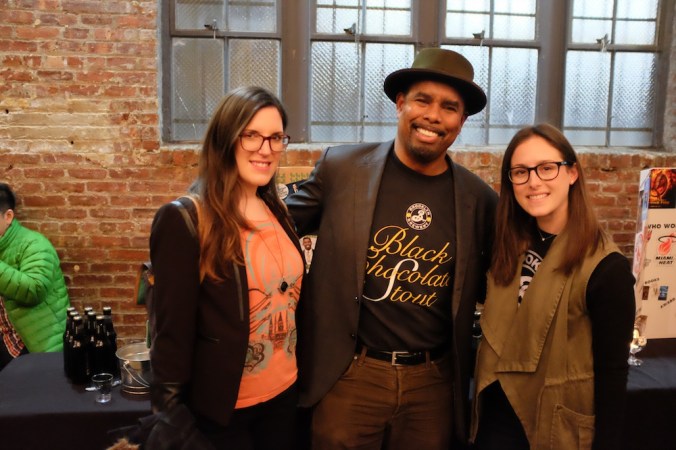
BeerAffair‘s Cat Wolinski and Brooklyn Brewery’s Garrett Oliver and Samantha Bernstein.
With NYC Beer Week 2016 in full swing, deciding on which events to attend each night becomes a bit challenging, to say the least. But on Monday, February 22, the choice was non-negotiable: Brooklyn Brewery invited select guests to attend the twenty-first birthday of the Black Chocolate Stout.
This was no ordinary birthday party. The Black Chocolate Stout holds significance at Brooklyn Brewery for several reasons. One is that the beer’s recipe was essentially the entry point into Brooklyn Brewery for Garrett Oliver, now brewmaster, who has since risen to worldwide fame for his beer making and beer-and-food pairing prowess. Another is that at the time of its original brew date in 1994, the beer, an imperial stout, was the most radical stout many beer drinkers had ever seen or tasted. Chocolate in a beer name?! Ten percent alcohol by volume?!
Finally, and perhaps most significantly for birthday bash attendees, the brewery has held onto nearly a dozen bottled iterations of the imperial stout since its origins. Originally announcing 10 vintages would be available, it turned out that there are, in fact, 11 vintages of Black Chocolate Stout available — a surprise 2007 was available on draft — making this event even more unique than we originally thought. The icing on the cake—the figurative one, not the chocolate one— was tasting and comparing each chocolately vintage with sweet early 2000’s tunes to sip to. Continue reading →
Flint Whistler of Rockaway Brewing Co. and Eric Hernandez of Coney Island Brewery.
NYC Beer Week kicks off this Friday, February 19 at 7pm with the “SimulTap,” or simultaneous tapping, of New York City beers, each brewed specially for Beer Week as part of a 10-day celebration of New York beer. Though the SimulTap marks the start of Beer Week every year, this year’s holds special significance because it will feature 15 NYC brewers’ beers made with State Malt and State Hops, being referred to as “SMaSH beers,” spotlighting local ingredients sourced right here in New York. NYC Beer Week is organized by the New York City Brewers Guild.
Note: SMaSH usually stands for “Single Malt and Single Hop,” meaning one type of malted barley or other malted grain and one type of hop are used in the brewing process. In this case, it stands for State Malt and State Hops. Three types of New York malt and three New York-grown hops were used to brew the NYC Beer Week SMaSH beers. Continue reading →



 Beer Affair