#WomanCrushWednesday: Julia Herz

#WomanCrushWednesday: Julia Herz

Julia Herz, Brewers Association Craft Beer Program Director. Photo via BrewersAssociation.org

#WCW: Julia Herz

Beer Cred:

Well Said:

“Our craft breweries are small businesses that have helped bring great innovation and a less gender-targeted approach to beer marketing than ever before—I’ll cheers to that!” – Weighing in on Women and Beer, craftbeer.com, Aug. 2015

Cheers to that, Julia!
– Beer Affair

Brewing Video Tutorials and Courses on the Cheap (and Free!)

Beer lovers are, more often than not, drawn to the craft beer scene after trying a new style or being introduced to a better form of the beverage. Before you know it, there are tap takeovers, beer festivals, day trips and vacations planned exclusively for breweries and basically, we pretty much have beer on the brain at all times. But even if you memorize every BJCP style guideline and keep up with all the latest trends, the only way to truly know beer is to make it.

If you’re interested in learning how to make beer and don’t have plans for the Siebel Institute or the  International Centre for Brewing and Distilling (ICBD) just yet, there are several online courses that will accomplish the basic “how to” of homebrewing without the hefty tuition. Here are three that are actually worth considering, both for their content and the cost.

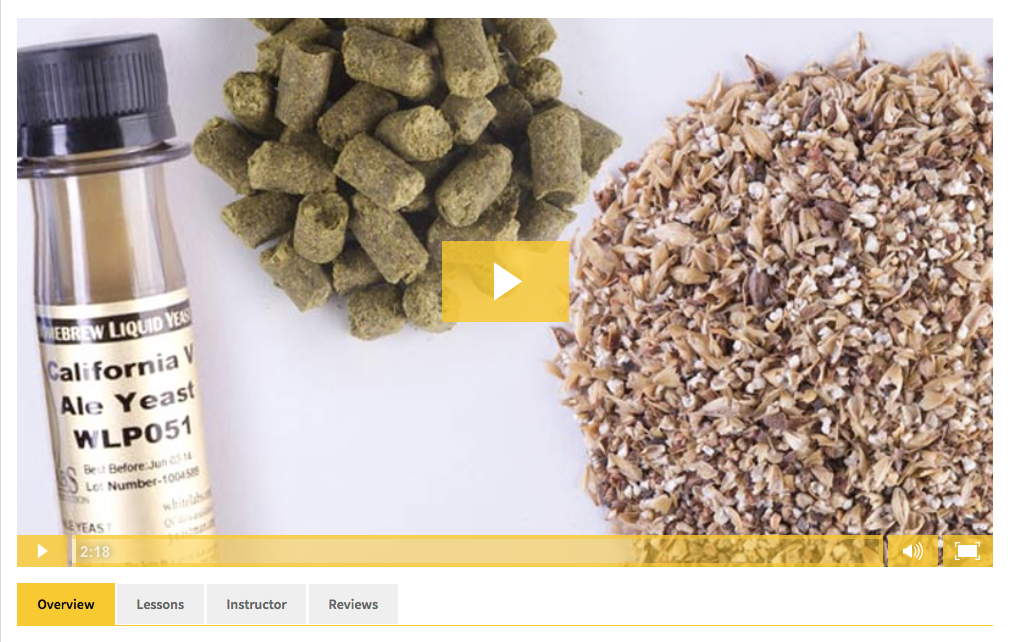
All-Grain & Partial Grain Brewing by Craft Beer & Brewing.

This intro video is only the beginning.

All-Grain & Partial Mash Brewing by Craft Beer & Brewing 
Price: FREE IF ENROLLED BY 8/25, otherwise $24.99, or $9.99/month for access to all Craft Beer & Brewing classes.

Along with publishing a monthly print magazine and regular digital content, Craft Beer & Brewing produces comprehensive brewing basics courses (as well as more advanced techniques) in their online homebrewing education platform. The course offerings range from extract brewing to partial to all grain, and each class offers step by step segments complete with downloadable, printable instructions and checklists for your brew session.

The video/slideshow/handout combo is a big draw for me, so even though I’ve been all grain brewing from the start, I’m registering for today’s free course and considering signing up for the monthly access. (My first foray into flavoring – strawberries and mint sprigs in a summer wheat ale – is currently fermenting, and I’d love to learn more about incorporating fresh ingredients into future brews. The yeast harvesting may have to wait.)

Enroll for the free class here – it’s FREE today (Tuesday, Aug. 25, 2015)!

Beer Brewing 101 by Brooklyn Brew Shop in collaboration with Brit + Co.

Look how happy she is after brewing her own beer!

Beer Brewing 101 by Brit + Co. and Brooklyn Brew Shop
Price: $19.99

Cutesy DIY fanatics, Brit + Co. recently collaborated with Brooklyn Brew Shop co-founder, Erica Shea to present Beer Brewing 101, a fun and easy guide to brewing a one-gallon batch of beer. The class uses Brooklyn Brew Shop’s Grapefruit Honey Ale beer making kit, which is also available for purchase at 10% off the original price of $40 when you buy the class for $20. The principles of this tutorial apply to any beer of any batch size, and divided by chapter, the course manages to condense the 4-6 hour brewing process down to less than 30 minutes of digestible, re-watchable content.

Check out Brooklyn Brew Shop’s blog post here or sign up for the class on Brit + Co.

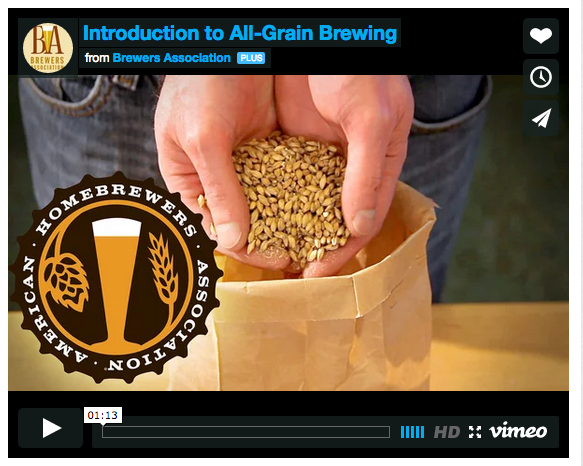
Introduction to All Grain Brewing by the AHA.

Feel the satisfaction and joy of turning grains into beer.

Introduction to All Grain Brewing by the AHA
Price: Free?!

Although they don’t advertise these as brewing classes per se, the American Homebrewers Association is also full of resources and information on how to brew at the Beginner, Intermediate and Advanced levels. These include videos, recipes, how-to guides and tips detailing the brewing process from start to finish (with pictures!).  As a member of the AHA, I’m thrilled to discover this – and I’m pretty sure it’s available for anyone to use.

Peek at the “Let’s Brew” section for a multitude of homebrew recipes and free offerings on how to brew.

Learning is cool, go do it!

Cheers,
Beer Affair

Bars We Love: Fetch a Few Brews at Luckydog! – Brokelyn

Luckydog has been a longstanding Brokelyn favorite due to its gruff and casual vibe, decent and cheap booze, and most significantly, its dog-friendly-bordering-dog-necessary policy.

All good things come to an end, however, even when man’s best friend is on your side. Despite unconditional love from local K9s, customers and even Yelp reviewers, Luckydog lost its pooch privileges (along with several other Brooklyn bars) when the New York Department of Health cracked its joyless whip across the borough last year.

The bar no longer gives its loyal locals the warm and fuzzies, but that doesn’t mean they don’t deserve your love money—in fact, on the contrary, they could use a little extra love right now. Next time you’re in South Williamsburg, stop in for a pint or two (Rockaway’s ESB was on tap last time I stopped in), maybe a bowl of water for old times’ sake, and reminisce about the days before doggy discrimination, when you would drink a beer with someone else’s animal next to you, or go to the bar next door because of your boyfriend’s allergies.

For some extra Luckydog intel, check out fellow Brokester, Kate Mooney’s look at the dog ban in her recent piece in the New York Observer, “Dining With Dogs: Here’s What’s in Store for Luckydog Bar in Williamsburg.”

#WomanCrushWednesday: Teri Fahrendorf

This is the second in a series highlighting women leaders in the beer and brewing industry in the U.S. For past crushes, visit the #WomanCrushWednesday tag at the end of this entry.

Teri Fahrendorf

#WomanCrushWednesday July 1, 2015: Teri Fahrendorf, founder and president of the Pink Boots Society. Photo via GirlTalkHQ.com.

Teri Fahrendorf, a self-described “woman beer professional” in the most general (albeit no less impressive) sense, is often celebrated in the craft brewing community for her many roles, contributions and accomplishments across her more than 25 years in the beer industry to date.

She is an acclaimed brewmaster of 19 years,  the second woman to ever achieve the “brewmaster” title in the U.S.¹, beginning at Golden Gate Brewing Co. in Golden Gate, Calif. in 1989 and concluding at Steelhead Brewing Co. in Eugene, Ore. in 2007 (at the latter, she served as corporate brewmaster of the company’s five locations for 17 years).

She was the first woman to be named class president at the Siebel Institute of Brewing Technology in Chicago, Ill., where she graduated in 1988.

She is a published author, contributing to such publications as New Brewer, Brewing Techniques, Zymurgy and American Brewer.

She is the “Road Brewer,” an absurdly ambitious and adventurous woman who spent five months camping across the States in a trailer, which she named Big Buddy, to visit and brew at various breweries (you can follow her experiences as she blogged along the way at roadbrewer.com).

In the course of her 25 year career, Fahrendorf has earned professional accolades and craft brewing achievements spanning three Gold Medals at the Great American Beer Festival (two in 1991 for her Station Square Imperial Stout and Raging Rhino Red, also known as Steelhead Amber, and one in 1999 for an Anniversary Ale); several annual seats as a Beer Judge at five international festivals; 18 speaking engagements as a speaker and education leader at events and conferences around the globe; and board titles as director, advisor or affiliate at five local and national brewing organizations.

Perhaps most significantly, Fahrendorf is known throughout the industry as founder and president of the Pink Boots Society, an international nonprofit association and trade organization created for the education and advancement of women beer professionals. The Society, which she founded somewhat serendipitously at the conclusion of her cross-country “road brewing” trip in 2007, now boasts 2,080 members and counting, chapters in 25 locations across the country, and hosts national as well as regional meetings in the U.S., U.K., Argentina, Australia and Europe.

According to Fahrendorf, seeds for the Pink Boots Society were planted throughout the five month road trip on which she visited 71 breweries across the country, brewing at 38 of them, and imparting her knowledge and expertise to newer female brewers along the way. As she recognized their skills, their want for education and the unanimous curiosity among them regarding other women in the industry (her own 19-year experience being quite exceptional), Fahrendorf saw the need for a way to inform women brewers about the others like them that were making brew-booted strides in the industry.

Inspired by the Red Hat Society and the squeaky rubber shoes on her own two feet, she created a list of the 60 women brewers she’d met along the way and coined it the “Pink Boots Society,” making it available, along with other resources, on her personal brewing and beer career website in 2007. Thus, an industry organization was born.

Eight years later, the Pink Boots Society continues to foster the female brewing community by “empowering women beer professionals to advance their careers in the beer industry through education,” by way of meetings, scholarships, volunteer opportunities and events that have gradually expanded, along with the Society’s membership itself, since its founding in 2007.²

At present, Fahrendorf is the specialty malt account manager at Great Western Malting in Vancouver, Wash., where she continues as “the West Coast’s unofficial craft beer ‘Goodwill Ambassador,'” as well as a speaker, beer judge and writer. Most importantly, she continues to inspire women like me, industry-wide and out, to march proud in our brewing boots as future leaders of the craft brewing movement in the U.S.

For a full history of Teri Fahrendorf’s brewing industry experience and accomplishments, visit terifahrendorf.com.


¹The first female brewmaster in the U.S. was Carol Stoudt, who acquired the role, at the eponymous Stoudts Brewing Company, in 1987.

²Although the Pink Boots Society originally began as a trade group exclusively for female brewers, it has since expanded to include any “woman who earns at least part of [her] income from beer.”

Craft Beer is Not a Fad

In a food and beverage market in which new iterations of products vie for consumers’ attention daily, if not hourly, a certain caste of critics like to claim that craft beer is a fad, a class of drinks in fashion for the time being that will eventually—perhaps literally—fizzle out. It is these commentators who are perfectly content sticking to the American lagers of yore, cracking bottle after bottle of Budweiser, patiently waiting for consumers to return to their comfort zone of cheap, flavorless beer.

Yet, as in other industries in which a new trend took hold of the nation, the beer industry is not simply experiencing a blip that will be forgotten when things return to business as usual. Business is not going to change to usual. The craft beer craze is here to stay, and it’s only going to continue growing as big beer companies, or at least their subpar products, gradually lose the ability to quench beer drinkers’ thirst for good beer.

The Levis Theory: Craft Beer is Here for Good (and Gender Neutral)

Craft beer is the denim jeans of pants. True, beer has its en vogue styles—double and imperial IPAs, Brettanomyces-fermented “horse blanket” sours and barrel aged-to-infinity barley wines may go the way of whitewashed jeans, Capri jeans and bell bottom jeans—but just as denim came into the picture and never left, people are not going to change their minds about drinking beer that better suits their needs.  Perhaps radical at the time, denim became a staple of the American (and Western) wardrobe for men and women everywhere, and people never stopped wearing it. They’re not going to stop drinking better beer, either.

The Playstation Theory: Craft Beer is Adapting to a Changing Market

Whether a gamer, Gen X-er, parent or arguably none of the above, almost everybody knows what Nintendo is. It’s the video game company that created Mario, the Mickey Mouse of video games, the arcade game from Japan that changed the world.

However, ask any modern gamer about Nintendo today, and they’ll shrug. No longer at the forefront of video game innovation, Nintendo has fallen by the wayside while it produces game after game with the same characters, for the same media. In the meantime, other, newer, console companies have been competing for first place: X Box and Playstation.

Playstation is continually coming out with new consoles, controllers, games and stories. Playstation 1, 2, 3 and 4 have each been relevant and coveted, even with X Box and X Box Live as its competitors. Year after year, both systems create new reasons to buy their consoles, their extensions, their games and those games’ new features.

Perhaps the most important distinction between Playstation/X Box and Nintendo is the existence and availability of (free) games in a medium that’s very important to players: the Internet (and in particular, mobile devices). While other video game companies have adapted to new technologies available to game players, Nintendo has famously faltered, preventing its products from becoming available for free or on mobile devices, and as such, it has been left behind. By refusing to adapt to changing consumer demands, the video game giant has become less successful.

As craft brewers invent new ways to make beer and create more locally-focused brews, holding their audience from batch to batch, big beer companies like Bud are slowly but steadily losing market share.

The Mrs. Meyers Theory: Craft Beer Costs More Because it’s Better for You and the Environment

When I was growing up, two or three brands of cleaning products shouted out for shoppers at local supermarkets. Chemicals had to be kept out of sight and under kitchen sinks because they could kill your children. Somewhere, meanwhile, Mrs. Meyers was brewing up new recipes for soaps and household cleaners in her eco-friendly kitchen.

As more environmentally conscious brands tried their hand at products that could actually clean your house without killing you—and look and smell good while they were doing—the next generation of house-cleaning consumers emerged. Names like “Method” and “Honest” bumped their pretty bottles up against harsh names on large containers like “Clorox” and “Windex.” Mrs. Meyers moved in next to Mr. Clean.

Budweiser and Coors may not be poison – I still drink it from time to time, just like I still use bleach to scrub my tiles from time to time – bleach will still clean your tiles incredibly well, just like Budweiser will still give you a buzz. But put simply, when there are better options, wouldn’t you rather do it better?

Compared to macro beers, micro-brewed beer is better for you because its ingredients maintain their nutritional integrity. In other words, the malted barley that is used to make beer and the liquid that’s extracted from it (along with what’s extracted from fruits, herbs and other ingredients included in many microbrews) stays present in the beer that you end up drinking.

This is not the case for major “lawnmower lagers.” Big brands remove much of the nutritional content in their beers via pasteurization to ensure homogeneity prior to sale. Craft brewers not only combat this “empty calories” scenario, but even serve to benefit the bodies of the health-conscious—used as a recovery beverage after a period of physical exertion, craft beer can actually replenish runners’ or cyclists’ electrolytes, as well as rebuild much needed muscle tissue due to vitamins present. (In fact, one Dutch study performed at the TNO Nutrition and Food Research Institute found that craft beer drinkers had 30 percent higher levels of vitamin B6 in their blood than non-drinkers, and twice as much vitamin B6 as wine drinkers.)

In my own experience, I have seen a considerable difference in the benefits of micro vs. macro beers in another area related to their ingredients: consumption. For myself and many friends, it has often been the assumption and practice that light beers are made for drinking in large quantities. Thanks to their being cheap, watered-down and easy to “chug,” they are ubiquitously present on college campuses to drink during activities that encourage binge drinking. If only for the sheer volume of bad beer drinking habits (beer pong, anyone?), experiences I’ve had and witnessed among the likes of Coors and Natural Light are not ones I would deign to repeat.

Craft beer, on the other hand, is meant to be savored. Even over a period of several hours, two companions might share two or four beers, as opposed to the dozen or more that could be crushed between the same people in the same amount of time otherwise. Studies have proven the benefits of moderate consumption of beer, qualifying the beverage as part of a healthy diet that can promote well-being, decrease risk of Alzheimer’s, achieve cancer-fighting antioxidants and contribute to LDL or “good cholesterol” which prevents heart disease. (Even further, a 2009 Tufts University study revealed that elderly test subjects who consumed a moderate amount of beer every day achieved higher bone density than those who abstained.)

Consumers’ tendency toward fewer, better, more thoughtfully crafted beers of a wide variety isn’t limited to “trendy” areas, either—the trend is taking hold across the United States, and it’s happening so rapidly in every region that a recent Brewers Association survey determined the majority of Americans live within 10 miles of a local brewery.

A fad implies a temporary fixation with a product or cultural item. The thousands of microbreweries cropping up across the country may be new, and surely many will fail. But the industry at its core will not fail and it is not temporary. Craft beer is a movement, both culturally and economically. As we gain more access to small and independent brewing companies making beers with fresh, local ingredients, we and the next generation of beer consumers will lose interest in lagers lacking flavor, inventiveness and versatility. We’re not drinking craft beer because it’s cool. We’re drinking it because we finally can.

Mondial de la Bière 2015: Montréal’s ‘World of Beer’ in Photos

On June 10 to 14, 2015, Mondial de la Bière celebrated its 22nd annual “World of Beer” Festival in Montréal, Canada. Located at the Palais des Congrès in the city’s downtown district, the festival joined together beer industry veterans, media personnel, tourists and local consumers for a five-day celebration of unique beers brewed in Canada and around the world.

A total of 85 breweries exhibited at the international expo, with 40 microbreweries from Quebec alone touting 226 new brews never before seen or tasted at the Mondial de la Bière. In all, 523 beers, meads and ciders were served, with beer alone comprising of 475 sample products.

As guests of Ale Street News, journalist-photographer team, Patrick Phillips and I took on the massive exhibition with vigor. Armed with our media bracelets, mugs and map of the festival’s indoor and outdoor floor plans, we captured as much as we could of the brewers, products and attendance on the show floor, the fine rare beers available in the VIP lounge, and the general essence of the final weekend on Friday, June 12 and Saturday, June 13.

Please enjoy the photo gallery below, showing our journey from our first day in VIP, our introduction to the main event, some standout brewers, beers and cheese, and an overall glimpse of the mind-opening, palate-expanding experience of Montréal beer.

Photos by Patrick Phillips. To view the slideshow, click the first image below and use the arrows to scroll.

#WomanCrushWednesday: Mellie Pullman

Now in a millennial world, it’s not so surprising that women are joining the beer community in troves, stepping onto the scene as sales representatives, marketing coordinators, reporters (ahem) and imbibers, and—although they are still few—brewers and brewmasters.

But before there were us gals who started appreciating good beer post-2000 (although we still may feel uniquely, utterly female in a scene that continues to be dominated by beer guts and beards), there were women like Mellie Pullman, who I’d like to spotlight for my first #WomanCrushWednesday (#WCW) post here on Beer Affair.

I do not mean this in the literal or romantic sense, as I’ve never met Pullman personally, I mean it simply in the sense that my “love affair with beer” (where the name Beer Affair came from) is due in part to women who flew their freak flags high before it was popular, or even possible, for gals like me to be a part of the beer community.

cbb-replantingtheseeds

“Replanting the Seeds of Brewing,” Craft Beer & Brewing, May 15, 2015.

After re-reading a feature written by Tara Nurin in Craft Beer & Brewing last month, “Replanting the Seeds of Brewing,” I was reminded of all of the women I have yet to meet, the history I have yet to learn, and the amazing strides women have made in this still-young industry since it began its second wind in the 1980s.

As a young woman swept up into the romance of the craft beer world just five or so years ago, I have to acknowledge the true pioneers before me, and commend these ladies for stepping up to the plate when it was even harder to be a female in a male dominated business like beer. (Or, as Nurin phrases it, for each woman who had to “finesse her way out of enough brewer-as-bearded-German-guy stereotypes.”)

In the days before national women’s industry groups like the Pink Boots Society (and in my case, local groups like the Beerded Ladies), these gals were among the first to explore the beer business, truly planting the “seeds” that sprouted roles for women in the brewing industry today. Among the “firsts” these femmes accomplished, Pullman is particularly #WCW-worthy for the following:

1. She was first female brewmaster in contemporary U.S. history;

2. She helped bring Utah its first brewery, Wasatch Brewery, in 1986; and

3. She lobbied to modernize the alcohol laws in Utah which were, even up until the late 80s, quite restrictive.

Beginning with Pullman and moving through the significance several more, Nurin’s article attributes beer props to Beth Hartwell, who co-founded Hart Brewing in Kalama, Wash. (now Pyramid Breweries) in 1984; Rosemarie Certo, who co-founded Dock Street Brewing in Philadelphia in 1985; Carol Stoudt, who became the nation’s first female sole proprietor-brewer in 1987; Barbara Groom and Wendy Pound, the first female ownership team in the industry, who opened Lost Coast Brewing in Eureka, Calif. in 1990; and Teri Fahrendorf, currently specialty malt account manager at Great Western Malting in Vancouver, Wash., who entered the industry at 1988 as a brewing intern and now has 19 years’ experience as a brewmaster and brewery supervisor at various locations.

Although you can take the woman out of the brewing industry (according to Nurin, Pullman left her post at Wasatch just three years after co-founding it), you can’t take the brewing industry out of the woman—Pullman is now serving as an associate professor at Portland State University, where she teaches several courses in the Business of Craft Brewing Certificate program.

Thoughts on L.A. BEER, the new webseries sitcom now streaming on YouTube

I take a positive tack on beer related ventures, so I’m not going to say L.A. BEER is terrible. All sitcoms are terrible. These guys and gals are trying though, and if it’s in the name of getting beer making in front of the masses, then I can try, too. The problem I have is, there’s hardly any beer making. Fair enough, but if we’re to assume the show is casting a wide net to catch viewers, then they’re missing the mark on two counts. For the beer nerds, there’s definitely not much going on in the beer knowledge department. For the vaguely beer curious, it’s unclear what these people are doing in their office every day if it’s not brewing.

In the five webisodes released in time for American Craft Beer Week, we see the struggle of fictional Los Angeles microbrewery, Silver Screen Brewing (how cute), in five quick and disheartening stages. In episode one, “New Brew,” the latest beer fails because it was made with a stinky Asian fruit (durian) in the brewer’s futile attempt to make something exotic (if that’s a reference to Ex Novo brewmaster, Jason Barbee, who brewed a Jacked Up Saison with one hundred cans of jackfruit, it’s only a compliment).

In episode two, “Silverlake Strawberry Ale,” another beer fails and is protested against by an angry mob of flannel-wearing mothers due to its kid-friendly label art (because hipster moms). In episode three, “Straight Up Shandy,” the boss fails to recognize one if his employees is homosexual, and said employee fails to stand up for himself (because being gay is hard and older white men don’t get it). Episode four, “Culver City Crowdfunding,” chronicles a Kickstarter campaign to can a beer gone wrong (because millennials) and episode five, “Fairfax Beer Fast” (where exactly is this brewery, anyway?), takes us through the lovely journey of the female employees attempting a juice cleanse that makes them go crazy to the point of becoming demonic, while the men have fun doing a beer cleanse (because girls are insane and think beer makes them fat).

Basically, these first introductions show nothing but failure in every corner of the brewing industry, from the launch of the brewery to the flagship beer to the marketing and distribution. Mix this in with a few staid personality types (the marketing bitch, the internet-and-approval-crazed intern, the gay guy and the clueless boss), a few lesbian and hipster jokes (or lesbian hipster jokes, as episode two would have it), and a few jabs at #craftbeerproblems and you’ve got yourself a sitcom. I guess?

The five episodes streaming right now total about 25 minutes all together, so it’s fair to say the production had to cut to the chase in terms of telling us who’s who and setting up their struggle. Fine, it’s your plot. But the parts that reinstate social assumptions like girls not drinking craft beer—even when it’s literally their job—leave room for improvement.

Some things the show is correct in portraying is that starting a brewery is hard, that the craft beer business involves a myriad of stages and issues and departments outside of the brewing itself, and that even brewers struggle to keep up with beer styles and sex appeal in a social media saturated market. But is it realistic? I don’t know, I’ve never worked in a brewery. My initial question still remains, though: Where’s the beer?

Brewing from Scratch: Ex Novo Brings Fresh Ingredients, Fresh Perspectives to Portland

ex novo brewing co

Ex Novo Brewing Company. Photo via Facebook.

Every brewery has its own style. There are the science buffs, who rely on organized spreadsheets, strict ingredient measurements and counting yeast cells in a petri dish to make sure attenuation is just right. Then there are the artistic types, who rely more on “feeling” and inspiration to create new brews on the fly. Then there are craft brewing’s political moderates, who prefer the level of organization necessary to keep a tight ship running smoothly, and are also ready to change course if a recipe route isn’t leading to the right place.

At Ex Novo Brewing Company in Portland, Ore., Jason Barbee is somewhere in the middle. Part scientist, part creator and part innovator, Barbee is the loveable mastermind behind Ex Novo’s new brews, which run the gamut from traditional Northwest amber to a saison packed with jackfruit. One thing that’s certain is, he’s here to mix things up.

Ex Novo Brewing Company opened in July 2014 under the direction of Joel Gregory, a young, even-tempered engineer-turned-brewer who gives the striking (albeit unlikely) impression that he opened this business overnight. The industrial space is sleek while welcoming: over the bar, a versatile beer list hangs over a row of just-cleaned taps; an equally adaptable food menu on the bar displays upscale-made-affordable small plates and sandwiches; and, neatly placed without sterilely uniform, high rectangular and low circular tables fill the majority of the front space, with booths against the wall, and kitchen hidden behind and a well-maintained brewery in back.

“This is my first brewery job, the one that I started,” says Gregory, who previously worked as an engineer in the electrical and renewable energy fields but felt his profession lacked creativity. “I like [engineering], but I never really felt I had any creative outlet and I wasn’t very good at it. I was always more business minded and creativity minded.”

The brewery’s name, “Ex Novo,” is a Latin phrase translating loosely to “from scratch”—an appropriate epithet for a business conceived of and set afloat with little guidance—and virtually no brewing experience.

If it’s a creative business he wanted, that’s certainly been accomplished—on top of his unbiased, nascent perspective on professional brewing, Gregory is planting a flag in wholly unchartered territory. Ex Novo is not only built “from scratch,” but is “the first and only nonprofit brewery in the country,” he tells us. After taking salaries and brewing expenses out of business revenues, his profits go to a selection of community-serving organizations that need money more than he needs a bigger house or new car.

Ex Novo founder Joel Gregory

Joel Gregory, Ex Novo Brewing Company founder and president.

As a homebrewer of five years with an itch for new ventures and an interest in nonprofit work, Gregory eventually came to the conclusion that opening his own nonprofit brewery would be the best and only way to combine his passions for beer and giving back. “A lot of [nonprofit] programs don’t need people, they need money,” he says. “This business model works—or can work if you do it right. I want to help that way.”

According to Gregory, the way to “do it right” is “being consistent and solid, and building something that people trust.” That’s hard to measure after just eight months, but being trustworthy is built into his business model; Ex Novo currently holds a commitment to four regional and international nonprofit organizations at $25,000 each, and has chosen a head brewer who has over six years’ experience at one of Portland’s craft beer mainstays, Deschutes Brewery.

The brewery currently runs as a three-man show with Gregory at the top as founder and general manager, Barbee as head brewer and Tommy as assistant brewer. In Gregory’s words, the brewery specializes in “lean, drinkable beers” that “occasionally get weird”—a description that may be hard to understand until you’ve tried them.

“We try to have something that anyone can walk in [and enjoy], whether they’re the farthest spectrum of beer geek or total novice,” says Gregory. He and Barbee agree that Ex Novo should, at least for now, incorporate a mix of styles agreeable to Portland’s many discerning palates. “We want to do those things and do them really well,” Gregory says.

Currently, that translates to brews like Damon Stoutamire, a balanced stout with dark chocolate, roast and slight coffee ntotes; How the Helles Are Ya’, a crisp, light lager with full body and German beechwood smoked malt; the self-explanatory Hoppy Pils; and Red Red Wheat, an amber wheat ale brewed with specialty malts and hops yielding sweet caramel and finishing off with a hint citrus. In case you think you’re getting the picture, there’s also the game-changing Jacked-Up Farmhouse, a fruity sour beer brewed with eight gallons of jackfruit, the origins of which beg an entire story of its own. In other words, we’d say the new breweries beers surpass “drinkable” and lean more toward novel, fresh and inventive.

Ex Novo head brewer, Jason Barbee

Ex Novo Brewing Company head brewer, Jason Barbee, caught in the act of tap cleaning.

Barbee, like many brewers, takes a seasonal approach to recipes and tap lists, requiring he always be thinking ahead. “We tend to brew seasonally and brew to what we want to drink,” Barbee says. “Right now, given that it is still not great outside in Portland”—he gestures to the floor-to-ceiling windows, whose view likely mirrors the concrete gray floors we stand on as the city’s daily dose of gloom rolls in—“we’ve got a peated Scotch ale, [which is] a bigger, boozier malt-forward beer, a traditional Northwest amber, in which you get a little more of that malt character and a lot more body coming through with a lot of hop, and we just transferred an imperial IPA yesterday. We try to think, ‘what will we want to be drinking four to six weeks from now?’”

At the time of our visit, on March 20, the first day of spring, Ex Novo has a few fermenting beers on deck that evidence its—and Barbee’s—versatility when it comes to an inaugural spring lineup. There’s a Maibock in one fermenter, readying itself for a lagering period that will precede its release in about six weeks; there’s a not-yet-released two hop double IPA that’s now, as I write this, on draft as Dynamic Duo IIPA, and in another metal fortress is a soon-to-be Belgian wheat with lime and juniper, meant to emulate a gin and tonic. The best seller, Barbee says, is the Eliot IPA, a creation he admits is not yet perfected. It’s also the one he brews the most, exemplifying why Ex Novo is the right fit for him.

“I have a lot more freedom here,” he says. “We’re so new that everything is still in development, which is fun. Even in our core brands, the recipes are so much in development; I have yet to brew Eliot the exact same way. I’m still trying to iron out the recipe to be exactly what we want.” Though he bears no hard feelings toward his past job, his position here at a brewery not yet a year old, and an innovative one from its very foundation, noticeably contrasts the six and a half year tenure as a Deschutes brewer. “[Each] new beer makes it exciting and fun to brew. There’s no set in stone recipe or magnate, and I don’t think that’ll ever happen.”

Though we didn’t know it at the time, Barbee sums up precisely what makes Portlandia a brewtopia, stating the sentiment of many Portland brewers:

“[Portland has] a really interesting beer scene because we really have the best of the best in terms of all the raw materials. Hops are all grown very locally, within driving distance…Wyeast is, in my opinion, the best yeast lab and they’re an hour from here. We have really good water. Great Western Malting and Country Malt Group are 10 miles from here. We have very good access to very high quality ingredients and lots of them.

“Plus, because we have such a loyal beer crowd, we get to be on the cutting edge of everything and people are accepting of that. We can brew whatever weird thing we can come up with and somebody will like it. As long as you’re making quality beer, you can pretty much brew anything you want and people will accept it.”

Though his family lives in North Carolina, Barbee has had no temptations to leave the Portland craft beer scene. “[The North Carolina beer scene] is really cool and growing a lot, but it’s a decade behind the scene here,” he says. Well played, but we sense another beercation in our future.