Beers to Drink and Brew this Fall: 5 Styles to Try and 5 to Make

I recently worked on two fall beer guides for craft beer novices and not-obsessed-but-interested drinkers. The first, published in Rally by Eventbrite, is a guide to popular beer styles that show up this time of year, along with specific suggestions of easy-to-find beers that also happen to be a few of my (approachable) favorites. The other, published in The Mash by Brooklyn Brew Shop, is a quick list for homebrew hopefuls who are looking to get their feet wet (or their brew boots wet, if they’re so experienced) with a few small batches this season.

In “Your Fall Beer Flavor Guide: Sip, Drink, Chug (No One’s Here to Judge)” AKA “Why You’re a Sucker if You Don’t Drink Spice Beer,” I walk through five craft beer styles that tend to hit the shelves as the summer transitions into leaf-falling, apple picking, hanging-out-in-bars-without-feeling-your-face-melt-off season:

  • Oktoberfest and Festbier
  • Pumpkin Beer
  • Harvest Ale
  • Herb and Spice Beer
  • Hard Cider (not beer, but see explanation in the post)

And since they’re psyched to spice up the season DIY-style, this Brooklyn Brew Shop list of “5 Fall Beers to Make Now” includes beer making kits and mixes that are perfect for fall imbibing:

  • Brooklyn Brewery Sorachi Ace
  • Rye-PA (Limited Edition)
  • Blackberry Red Ale (Limited Edition)
  • Chestnut Brown Ale
  • Chocolate Maple Porter

Of course, these are all great beers to drink or brew any time, but it’s always fun to get festive when the options are as vast as they are!


What it Means to Live Like a Local [Infographic]

After a recent bike ride to Alewife in Long Island City, Queens, I spotted a magazine on the table of promotional papers and publications that I’d never seen before: Upstater.  As a lifelong lover of Upstate New York (a history that starts with an annual trip to Lake George with my family since the age of one, and ends, as of a week ago, with a sixth trip upstate this summer alone), I snatched it up excitedly and stuffed it into my bag, along with Boro Magazine and a few postcards, to devour later that evening. (The only appropriate things to devour at that moment were my Hill Farmstead beer, fig and brie grilled cheese, and Pat’s undivided attention.)

The magazine’s mission statement struck me as soon as I turned to it later that night:

“This magazine is dedicated to living a connected life.
Connected to nature. Connected to where our food comes from. Connected to our families. Connected to our work.
Connected to our community.
We like making:  Building with our hands. Growing our own food.
Making cocktails. Making plans with friends. Making dinner. Making love. Making time to live our wildest dreams.
That’s what living local means to us.

Live like a local.

I liked the message so much, I immediately tore it from the book, folded its edges and taped it to the small bulletin board I finally have hanging on my brand new (15-year-old hand me down) desk. Yes, it’s a little cheesy. Yes, it’s easy to say these things when you live the “simple life” of an upstater, or live in the country, or live on a farm. Yet, I thought, if there’s any safe space for me to share something meaningful, it’s here. Since I have the chance, I’m passing this along in hopes of inspiring a few of my urban comrades to start thinking local, even when that means (as it often does) putting in a little extra effort—and probably a few extra cents.

How to Live Like a Local in Three Easy Steps

  1. Next time you’re out at a bar, order a local beer. It took more work than you can imagine, from the barley farms to malt houses to hop yards to the brewery, to get that beer in your glass. Savor it.
  2. At the grocery store this week, while you’re mulling over which cheese or milk to buy, try looking at the labels to learn about where they came from. See which ones are from New York. I guarantee you’ll see at least one, and if you don’t, ask the manager about it.
  3. At the very least, when you’re stocking up on produce, skip the freezer section. Skip the supermarket altogether and try the mom and pop down the street. You’ll make their day—and a much better meal.

Upstater’s mission statement is posted in the website’s “About” section as an attractive infographic identical to the page in print. Take a look and pass it along to the makers, dreamers, and—most importantly—the doubters in your life.

UpstateMagazine_MissionStatement

#WomanCrushWednesday: Wendy Littlefield

Wendy Littlefield. Photo via LinkedIn.com

Wendy Littlefield. Photo via LinkedIn.com

#WCW: Wendy Littlefield

Beer Cred:

In honor of Brewery Ommegang’s 18th birthday next month and my departure for Belgium today, this week’s #WomanCrushWednesday goes to Wendy Littlefield. Along with her husband, Ed, Littlefield’s accolades go far beyond a bulleted list. From a romantic start of eloping in college, moving to Belgium and falling in love—with the tradition and taste of Belgian beer, that is—she became the first American woman inducted into the Belgian Brewers Guild and was nominated for the Mercurius Award, the highest civilian honor bestowed by the Belgian government.

Back stateside,  in addition to starting two beer businesses, she started several community-driven food and drink events and associations in her now-hometown of Cooperstown, N.Y. (Belgian Comes to Cooperstown among them). You can learn more about the Littlefields in the self-told “Very Long and Boring Story” of  her career in beer—a lengthy one, yes, but there’s nothing boring about it.

Well Said:

“We have been at this business for 31 years and still adore it, and we are still married and capable of working together. How very fortunate we are. We think of ourselves as cultural anthropologists explaining culture through beer.” – “Why We Do What We Do— An Interview With Our New York Distributor,” March 2012, BelgianBeerExperts.com 

#WomanCrushWednesday: Carol Stoudt

Photo via The Daily Meal

Photo via The Daily Meal

#WCW: Carol Stoudt

Beer Cred:

Carol Stoudt is often touted for being a craft beer pioneer,  and not only as a woman—she was crowned “Queen of Hops” (a media-given title) as the first female brewmaster and brewery owner in American history post prohibition, but was also one of the first brewmasters and brewery founders of that time, starting her business in what was arguably the most important year of the craft beer revolution, 1987. Filling rolls that were hardly there to be filled, Stoudt showed the country that craft beer belonged here, and she’s continued to do so for the last 28 years.

Well Said:

“My advice to anyone wanting to get in the business is to work in a variety of types and sizes of breweries or restaurants, as well as sales, if one is planning a micro. One needs not only passion but a willingness to work hard in all areas.” – Journey to the Beer Store, April 11, 2013

Beer and Cheese Pairing Guidelines [Infographic]

There are a few places where the harmony of beer and cheese have been brought to my attention: at the Mondial de la Bière festival in Montreal, where trays of cheeses I’d never seen before sat casually beside rows of Quebec-brewed beer; at Otter Creek Brewing in Middlebury, Vt., where one can enjoy a plate of award-winning cheeses with a pint of award-winning Wolaver’s Pumpkin Ale; and of course, in my own kitchen, where we regularly experiment with flavor combinations in our favorite foods and brews. (There are few last-minute lunches more satisfying than a gouda and sharp cheddar grilled cheese with a homebrewed American pale ale—I urge you to try it).

The practice of beer pairing can be applied to any food item or cuisine, but doing it with cheese has a history older than the swiss you’ll want to pair with a bock after reading this. For those new to the practice, this infographic from Visually* slices beer and cheese pairing into bite-sized guidelines that anyone can enjoy and experiment with.

Please do try this at home:

Beer and Cheese Pairing Guide

 *Beer & Cheese Pairing Guidelines was originally posted on the RedEnvelope blog, which apparently no longer exists.

Beer Quote: Dave Carpenter on Fresh Hops

“Fresh hops remind us that there is virtue in reserving some things for special occasions.” — Dave Carpenter, “The Last Seasonal,” Craft Beer & Brewing Magazine,  Aug.-Sept. 2015

I truly savored this Brewers’ Perspectives feature unveiling commercial craft brewers’ approaches to utilizing the extremely ephemeral wet hop. With harvest season upon them, Left Hand Brewing Company ( Warrior IPA), Crazy Mountain Brewery (Sticky Fingers Wet Hopped Ale) and Comrade Brewing Company (Superpower IPA, a 2014 Great American Beer Festival Silver Medal winner in the Fresh or Wet Hop Ale category) each demonstrate the delicate nature of fresh, local hops, and the worth of going great lengths to achieve them.


Photo credit: Dave Carpenter “Hops Harvest 2015: Meet the Hops Harvesters

#WomanCrushWednesday: Jill Redding

#WomanCrushWednesday is a BeerAffair series highlighting female leaders of the beer and brewing industries. View past crushes by clicking #WomanCrushWednesday or #WCW.

Jill Redding, editor for the Brewers Association.

Jill Redding, editor-in-chief at the Brewers Association.

#WCW: Jill Redding

Beer Cred:

As the Brewers Association editor-in-chief, Jill Redding is responsible for overseeing the bi-monthly publication (every two months) of Zymurgy,  a magazine “for the homebrewer and beer lover” which informs amateur beer makers on trends, best brewing practices, award-winning recipes and industry events, and the New Brewer, “a passionate voice for craft brewers,” created to provide commercial startup breweries with information on topics like brewing technology, problem solving, and management.

The Brewers Association (BA) is a non-profit trade association established “to promote and protect American craft brewers, their beers and the community of brewing enthusiasts.” In addition to its publications, education, insights and statistics pertaining to the craft brewing industry, the BA is responsible for major industry events such as the Craft Brewers ConferenceGreat American Beer Festival, SAVOR and World Beer Cup.

Well Said:

“Kudos to all homebrew clubs for teaching the world to brew, and for giving back to their communities!” — Brew’s Up, Indeed, Zymurgy Vol. 38 No. 5


Cheers, Jill!
Beer Affair

Is this the most significant deal in the U.S. craft brewing industry?

The Press Democrat is billing the partnership between Lagunitas Brewing Co. and Heineken International “the most significant deal yet in the American craft brewing industry.” Is it?

Tony Magee, founder of Lagunitas Brewing Co. Photo via the Press Democrat.

Tony Magee, founder of Lagunitas, has happily partnered with Heineken. Photo via the Press Democrat.

Last week’s announcement, which also appeared on the Lagunitas and Heineken websites on September 8, described the 50-50 deal as a powerful new partnership that will allow Lagunitas to export their craft beer globally. A strategic move for both parties, to be sure, but what does it say about Lagunitas as a member of the craft beer industry? Is it worth losing the status as “small and independent,” as the Brewers Association defines craft brewery, for an export deal?

Here are the key points of the deal:

  • Lagunitas will continue to operate independently in the US
  • Tony Magee, Lagunitas founder, will remain at the helm
  • Leadership and staff, recipes, suppliers and distributors will remain the same
  • Lagunitas will be able to sell their beer worldwide
  • To keep up with growth, a third Lagunitas brewery is under construction in Azusa, Calif., scheduled to open in 2017

Lagunitas, based in Petaluma, Calif., was listed in as No. 6 in the Brewers Association’s Top 50 U.S. Craft Brewing Companies of 2014. For the Top 50 Overall, it sat at No. 11. Since ratings are based on 2014 sales volume, it’s clear Lagunitas is selling a lot of beer.

So, why stop there? Isn’t that the purpose of starting a brewery in the first place? By sacrificing their status as sixth among the craft brewers, Lagunitas is elevating its status as a brewer, period. If given the opportunity to sell your beer overseas, wouldn’t you take it?

Basically, what I’m getting at is, they’re not wrong.

In the words of Tony Magee, founder of Lagunitas, the partnership is “a profound victory for American craft. It will open doors that had previously been shut and bring the U.S. craft beer vibe to communities all over the world.” That all sounds great, but consider the reverse: isn’t Lagunitas giving Heineken the opportunity to gain a foothold in the craft beer industry here? Aren’t those “doors” swinging doors?

A lot of questions will continue to surface as the deal unfolds. (Will Lagunitas grasp more market share with Heineken’s fists? Will Heineken be brewing Lagunitas’ beer, and vice versa? Will Heineken “partner” with more U.S. craft breweries, taking hold of similarly positioned companies like Sierra Nevada, New Belgium and Gambrinus? Is this as bad as Anheuser-Busch snatching up Elysian, Blue Point and Goose Island?  Will what happened to Dick Cantwell at Elysian happen to Magee?)

After the sudden trepidation passes (if it ever does pass), maybe we’ll start to see that these partnerships aren’t such a bad thing. All we can hope for is that our still-small, still-independent breweries aren’t pushed out further by one of their own.

Read Tony Magee’s (thoughtful, very verbose) blog post on the recent news here.


#WomanCrushWednesday: Julia Herz

#WomanCrushWednesday: Julia Herz

Julia Herz, Brewers Association Craft Beer Program Director. Photo via BrewersAssociation.org

#WCW: Julia Herz

Beer Cred:

Well Said:

“Our craft breweries are small businesses that have helped bring great innovation and a less gender-targeted approach to beer marketing than ever before—I’ll cheers to that!” – Weighing in on Women and Beer, craftbeer.com, Aug. 2015

Cheers to that, Julia!
– Beer Affair

Brewing Video Tutorials and Courses on the Cheap (and Free!)

Beer lovers are, more often than not, drawn to the craft beer scene after trying a new style or being introduced to a better form of the beverage. Before you know it, there are tap takeovers, beer festivals, day trips and vacations planned exclusively for breweries and basically, we pretty much have beer on the brain at all times. But even if you memorize every BJCP style guideline and keep up with all the latest trends, the only way to truly know beer is to make it.

If you’re interested in learning how to make beer and don’t have plans for the Siebel Institute or the  International Centre for Brewing and Distilling (ICBD) just yet, there are several online courses that will accomplish the basic “how to” of homebrewing without the hefty tuition. Here are three that are actually worth considering, both for their content and the cost.
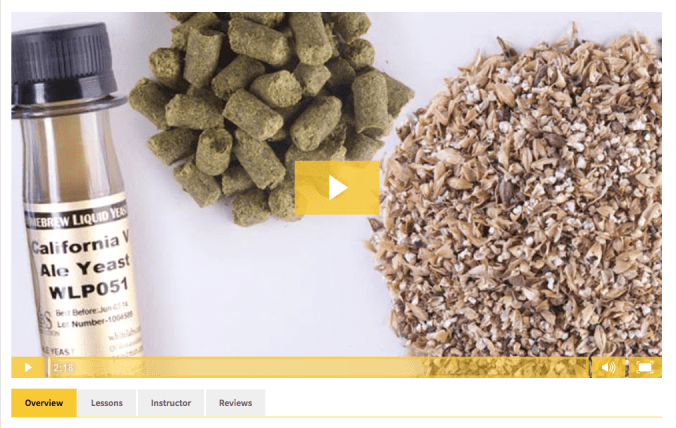
All-Grain & Partial Grain Brewing by Craft Beer & Brewing.

This intro video is only the beginning.

All-Grain & Partial Mash Brewing by Craft Beer & Brewing 
Price: FREE IF ENROLLED BY 8/25, otherwise $24.99, or $9.99/month for access to all Craft Beer & Brewing classes.

Along with publishing a monthly print magazine and regular digital content, Craft Beer & Brewing produces comprehensive brewing basics courses (as well as more advanced techniques) in their online homebrewing education platform. The course offerings range from extract brewing to partial to all grain, and each class offers step by step segments complete with downloadable, printable instructions and checklists for your brew session.

The video/slideshow/handout combo is a big draw for me, so even though I’ve been all grain brewing from the start, I’m registering for today’s free course and considering signing up for the monthly access. (My first foray into flavoring – strawberries and mint sprigs in a summer wheat ale – is currently fermenting, and I’d love to learn more about incorporating fresh ingredients into future brews. The yeast harvesting may have to wait.)

Enroll for the free class here – it’s FREE today (Tuesday, Aug. 25, 2015)!

Beer Brewing 101 by Brooklyn Brew Shop in collaboration with Brit + Co.

Look how happy she is after brewing her own beer!

Beer Brewing 101 by Brit + Co. and Brooklyn Brew Shop
Price: $19.99

Cutesy DIY fanatics, Brit + Co. recently collaborated with Brooklyn Brew Shop co-founder, Erica Shea to present Beer Brewing 101, a fun and easy guide to brewing a one-gallon batch of beer. The class uses Brooklyn Brew Shop’s Grapefruit Honey Ale beer making kit, which is also available for purchase at 10% off the original price of $40 when you buy the class for $20. The principles of this tutorial apply to any beer of any batch size, and divided by chapter, the course manages to condense the 4-6 hour brewing process down to less than 30 minutes of digestible, re-watchable content.

Check out Brooklyn Brew Shop’s blog post here or sign up for the class on Brit + Co.

Introduction to All Grain Brewing by the AHA.

Feel the satisfaction and joy of turning grains into beer.

Introduction to All Grain Brewing by the AHA
Price: Free?!

Although they don’t advertise these as brewing classes per se, the American Homebrewers Association is also full of resources and information on how to brew at the Beginner, Intermediate and Advanced levels. These include videos, recipes, how-to guides and tips detailing the brewing process from start to finish (with pictures!).  As a member of the AHA, I’m thrilled to discover this – and I’m pretty sure it’s available for anyone to use.

Peek at the “Let’s Brew” section for a multitude of homebrew recipes and free offerings on how to brew.

Learning is cool, go do it!

Cheers,
Beer Affair